
Switching NDIS providers is more common than you might think, and it is entirely your right as an NDIS participant. Under the NDIS principles of choice and control, you are empowered to select the providers that best support your goals and your life. If your current provider is no longer meeting your needs, you have every right to explore other options.
The good news is that changing providers does not automatically affect your NDIS funding or your current plan. When managed correctly, the transition can be smooth and straightforward. This simple guide walks you through exactly how to switch NDIS providers in NSW, step by step, so you can make the change with confidence.
Can You Change Your NDIS Provider?
Yes, you can change your NDIS provider at almost any time. This is one of the foundational rights built into the NDIS framework. The scheme was designed to put NDIS participants in the driver’s seat, giving you the ability to choose, change, and direct the support you receive.
Whether you are self-managed, plan-managed, or NDIA-managed, you have the right to change providers if your current arrangement is not working. Your NDIS plan remains active throughout the process, and your NDIS funding stays with you, not with your provider.
Participants should follow the NDIS process when changing providers to avoid disruptions to their supports. That means reviewing your current service agreement, giving appropriate notice, and arranging your new provider before you leave. Done this way, your NDIS journey continues without unnecessary interruption.
Common Reasons People Decide to Leave Their Current Provider
People switch providers for many different reasons, and all of them are valid. Some of the most common include:
- Poor communication or slow responses from support workers or coordinators
- Supports that no longer align with your goals or your current NDIS plan
- Moving home to a new suburb, city, or region
- Finding better or more specialised services elsewhere
- Wanting a provider with greater flexibility around scheduling and service delivery
- Wanting a provider that is more connected to your local communities
- Changes in support worker staffing or a lack of consistency
- Concerns about staff training, skills, or qualifications
- Wanting a provider with stronger quality and safeguarding practices
- Simply feeling like a better fit exists somewhere else
Whatever your reason, it is important to remember that you are not locked in. Your wellbeing and your goals come first.
Step 1: Review Your Current Service Agreement
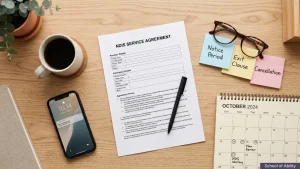
Before you do anything else, locate your current service agreement and read it carefully. This document outlines the terms of your relationship with your provider, including what is required when ending the arrangement.
Key things to look for include:
- Notice periods: how many days’ notice you must give before ending the agreement (typically 2 – 4 weeks, though this varies)
- Cancellation clauses and any conditions that apply
- Outstanding invoices or payments that need to be settled
- Exit procedures: any required steps or final appointments
- NDIS pricing arrangements: confirming that the provider has been charging within NDIS pricing guidelines
- Cancellation fees: whether any apply and under what circumstances
- Service bookings: understanding any active bookings held against your NDIS funding
Every service agreement is different, so take the time to understand what yours says. If you are plan-managed, your plan manager can help you interpret the terms.
Step 2: Find a New NDIS Provider Before You Leave

One of the most important steps in switching providers is making sure you have a new provider lined up before you exit your current one. Leaving without a replacement in place can create gaps in your supports, which can affect your daily life and wellbeing.
When researching registered providers, consider the following:
- What types of supports do they offer: daily personal activities, community access, capacity building, supported independent living?
- Are they a registered NDIS provider? (Required if you are NDIA-managed)
- What is their availability in your area?
- What do other participants say about them?
- How do they communicate with participants and families?
- What does their onboarding process look like?
It is worth meeting or speaking with potential providers before you commit. A good provider will take the time to understand your goals, your preferences, and what success looks like for you.
Note: If you are self-managed, you can use both registered and unregistered providers. If you are plan-managed, you have the same flexibility. If you are NDIA-managed, you must use registered NDIS providers.
Step 3: Tell Your Current Provider
Once you have reviewed your agreement and identified your new provider, it is time to notify your current provider. This should be done in writing, an email is perfectly acceptable and creates a clear record of when notice was given.
Your written notice should include:
- Your name and NDIS number
- The date you are giving notice
- The date you intend to end the service agreement
- A brief, professional explanation (optional but courteous)
There is no need to go into excessive detail. Being professional and respectful throughout this process makes for smoother transitions and protects your interests. Discuss any final appointments that need to take place and confirm the handover process.
Remember, leaving your NDIS provider does not have to be stressful. Keeping communication clear and documenting everything in writing is the best way to protect yourself and make the process straightforward.
Step 4: Update Your NDIS Records
After giving notice, you will need to update your records in the myplace portal (also referred to as the NDIS participant portal or NDIS portal). This is where provider relationships are managed and service bookings are recorded.
Steps to complete in the portal include:
- Log in to the myplace portal at ndis.gov.au
- Navigate to “My Providers” and update or remove your current provider
- Check for any active service bookings and ensure they are ended or transferred appropriately
- Add your new provider relationship once confirmed
You should also notify your plan manager (if applicable) and your local area coordinator (LAC). These are important steps that help avoid payment confusion and ensure your support continues without gaps.
If you are unsure about any steps in the portal, contact the NDIS directly on 1800 800 110 or visit an NDIS office for assistance.
Step 5: Begin Services With Your New Provider
Once your notice period has ended and your records are updated, you are ready to start with your new provider. This is an exciting part of the process, a fresh start with a provider that is better aligned with your goals.
When beginning services:
- Review and sign a new service agreement before supports begin
- Share your current NDIS plan with your new provider so they understand your goals and funding categories
- Discuss your preferences, routines, and support needs in detail
- Confirm scheduling, communication channels, and how concerns will be handled
- Set expectations early to build a strong working relationship from day one
Continuity of support is key during this period. A good provider will prioritise getting up to speed quickly so you experience minimal disruption.
NDIS Provider Switching Checklist

Use this NDIS provider switching checklist to make sure you have covered every step:
- Review your current service agreement
- Check notice periods and cancellation clauses
- Research and compare registered NDIS providers
- Meet with or speak to your shortlisted providers
- Confirm your new provider before giving notice
- Notify your current provider in writing
- Settle any outstanding invoices
- Inform your plan manager of the change
- Inform your local area coordinator if applicable
- Update your provider relationships in the myplace portal
- Cancel or transfer any active service bookings
- Sign a new service agreement with your new provider
- Share your NDIS plan with your new provider
- Confirm your first scheduled support
- Keep copies of all correspondence and documents
- Confirm a smooth transition is in place
Does Switching Providers Affect Your NDIS Funding?
In most cases, no. Switching providers does not affect your NDIS funding. Your funding belongs to you as an NDIS participant, it is allocated to support your goals and is tied to your current plan, not to any specific provider.
When you leave your current provider, any unspent funding that was held under service bookings returns to your plan and becomes available for your new provider. Your current plan remains active throughout the process.
There are a small number of administrative situations where you may need to take extra steps, for example, if your current provider has a service booking that has not been closed, or if there are outstanding invoices. This is another reason why it is important to review your service agreement carefully and keep your plan manager informed throughout the process.
The key point is this: your NDIS funding follows you, not your provider.
What If You Experience Problems While Changing Providers?
While most provider transitions are straightforward, issues can occasionally arise. Here is what to do if you encounter difficulties:
If your provider refuses to cooperate or delays your exit
Review your service agreement to confirm you have met all notice and exit requirements. Document all communication in writing. If the provider continues to act unreasonably, you can escalate the matter.
If you have a service dispute
Try to resolve the issue directly with the provider in the first instance. If that is not possible, contact your plan manager or local area coordinator for assistance.
If you believe a provider has breached the NDIS Code of Conduct
You can lodge a complaint with the NDIS Quality and Safeguards Commission. The Commission oversees NDIS quality and safeguarding obligations and handles complaints about registered providers. Visit ndiscommission.gov.au or call 1800 035 544.
If you need general assistance
Contact the NDIS on 1800 800 110. The NDIS can help clarify your rights, guide you through the myplace portal, and connect you with further support if needed.
You should never feel trapped with a provider that is not right for you. The NDIS framework exists to protect your choice and control throughout your NDIS journey.
How School of Ability Makes Switching Easy

At School of Ability, we understand that changing providers can feel overwhelming. That is why we take a person-centred approach from the very first conversation, listening to your goals, your concerns, and what you need from a provider going forward.
When participants come to us after changing providers, we support them by:
- Guiding them through our onboarding process at their own pace
- Communicating directly with plan managers to avoid funding gaps
- Working with local area coordinators to ensure continuity of supports
- Helping with any paperwork or documentation required during the transition
- Setting up supports quickly so participants experience minimal disruption
We are a registered NDIS provider supporting participants and their families across Greater Sydney and Northern Rivers. Our services cover a wide range of NDIS support categories so that your needs are met under one provider, including:
- Assist-Personal Activities: hands-on support with daily personal tasks such as grooming, hygiene, dressing, and meal preparation
- Assist-Travel/Transport: helping participants travel safely to appointments, community activities, and everyday destinations
- Innovative Community Participation: innovative, tailored programs that build skills and confidence through community engagement
- Development of Life Skills: structured support to develop the everyday skills needed to live more independently
- Household Tasks: practical assistance with cleaning, laundry, and other household responsibilities
- Participation in Community: support to engage in social, recreational, and civic activities within local communities
- Group/Centre Activities: group-based programs delivered at our centre and in the community, focused on connection, skill-building, and enjoyment
Whether you need support at home, in the community, or in a group setting, our team is equipped to deliver services that genuinely make a difference to your everyday life.
If you are thinking about making a change, we are happy to have a no-obligation conversation about how we can support you. Reach out to our team, we would love to hear from you.
Ready to Make the Switch?
Switching NDIS providers is a normal, protected part of your NDIS journey. If you take the time to plan ahead, by reading the service agreement, arranging your new provider, communicating clearly, and updating your records, the process is manageable and straightforward.
You deserve support that is really for you and that can help you reach your goals. If your current provider isn’t, you have the right to look around.
Frequently Asked Questions
Can I switch NDIS providers mid-plan?
Yes. No need to wait for a review or renewal of your plan to change providers. A change may be made anytime during the current plan as long as you follow the exit procedure in your service agreement.
Will I lose my NDIS funding if I switch providers?
No. Your NDIS funding is linked to your plan, not your provider. If any money is not spent on services booked, it will be returned to your plan when the booking closes.
How much notice do I have to give my current provider?
The length of notice depends on your service contract. Most agreements call for between two and four weeks' notice, although it may vary. Before giving notice, be sure to review your agreement.
Can I change providers if I am plan-managed?
Yes. Plan managed participants can work with registered and unregistered providers. Your plan manager can assist you with the transition and make sure that payments are made appropriately.
Can I change providers if I am NDIA-managed?
Yes, but NDIA managed participants have to use registered NDIS providers. Before changing providers, ensure that your new provider is registered.
Can I use unregistered providers?
Self-managed and plan-managed participants can use both registered and unregistered providers. NDIA-managed participants must use registered providers only.
Do I need to tell my local area coordinator?
It is a good idea to keep your local area coordinator informed when changing providers, particularly if they have played a role in coordinating your support. They can assist with smooth transitions and help update your records where needed.
What happens in the myplace portal when I switch providers?
You will need to update your provider relationships in the myplace portal. This involves removing your current provider and adding your new one. Any active service bookings will also need to be reviewed and updated. If you need help navigating the portal, contact the NDIS on 1800 800 110.
Can I switch NDIS providers more than once?
Yes. There is no limit on how many times you can change providers. Your choice and control as an NDIS participant is ongoing.
What if my current provider refuses to let me leave?
Providers are not legally allowed to stop you from leaving. If your provider is not willing to cooperate, keep a record of all communications and report the issue to the NDIS Quality and Safeguards Commission. The NDIS can also provide you with advice.