
If you’ve recently received your NDIS plan or you’re helping a loved one understand theirs, you’ve probably noticed a section called Core Supports. It’s usually the largest chunk of funding in a plan, and yet it’s one of the most misunderstood parts of the NDIS.
People ask us all the time: “What are core supports in the NDIS, exactly? Can I use this funding for X? What’s actually allowed?”
This guide answers all of that in plain English. No jargon, no guesswork, just a clear, practical breakdown of what NDIS core supports are, what falls under each category, and how to make the most of your budget.
What Are Core Supports in the NDIS?
Core Supports are one of three main funding categories in an NDIS plan (the others are Capital Supports and Capacity Building Supports).
Core Supports are designed to fund the everyday assistance you need to live your life, the practical help that keeps things running day to day. Think personal care, household help, getting out in the community, and transport.
The NDIS calls these supports “Core NDIS Support” because they address your foundational, day-to-day needs rather than longer-term skill-building or equipment purchases.
Quick definition: Core Supports fund the assistance you need right now to participate in daily life. They’re flexible, practical, and for most participants make up the bulk of their NDIS plan funding.
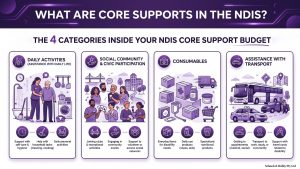
The 4 Categories Inside Your NDIS Core Support Budget
Your NDIS core support budget is divided into four sub-categories. Here’s what each one covers.
1. Daily Activities (Assistance with Daily Life)
This is usually the biggest portion of any core support budget, and it’s the one most participants use most frequently.
NDIS daily activities funding covers personal care and practical assistance to help you manage your everyday routine. These things would be difficult or impossible to do independently because of your disability.
What NDIS daily activities funding can pay for:
- Help with showering, bathing, and personal hygiene
- Assistance with dressing and grooming
- Continence support and management
- Meal preparation and eating assistance
- Overnight support or sleepover care
- Assistance getting in and out of bed
- Help manage medication under supervision
- Supported independent living (SIL) top-up support
- Help with household tasks like cooking, cleaning, laundry, and shopping (when related to your disability needs)
At School of Ability, our Daily Personal Activities service is funded under this category. We provide dignified, person-centred assistance that respects your choices and routines.
We also deliver Household Tasks support, helping participants maintain a clean, organised, and safe home environment.

2. Social, Community and Civic Participation
This category of funds supports you in getting out, connecting, and participating in life beyond your home.
The NDIS recognises that social connection is not a luxury, it’s a health and wellbeing essential. This funding is for the support you need to take part in activities, events, and community life alongside everyone else.
What this category can pay for:
- A support worker accompanying you to social events, outings, or activities
- Support to attend community groups, clubs, or classes
- Assistance to participate in recreational activities (sports, arts, hobbies)
- Support to volunteer or engage in civic life
- Group-based social programs with other NDIS participants
- Assistance to attend religious or cultural events
- Support at birthday parties, family gatherings, or community celebrations
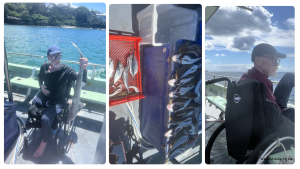
Our Participation in Community, Social and Civic Activities service falls under this category. Our support workers walk alongside participants to help them explore their community with confidence, building friendships and connections along the way.
We also offer Innovative Community Participation, creative, structured programs designed to build social skills and help participants engage meaningfully with people around them.
3. Consumables
This category covers day-to-day disability-related products and items that you use regularly and need to replace over time.
What consumables funding can pay for:
- Continence products (pads, catheters, wipes)
- Low-cost assistive technology under $1,500 (per item)
- Wound care and nursing supplies
- Enteral feeding supplies
- Recreational therapy items (at lower levels)
- Certain mobility aids and everyday assistive equipment
Consumables are typically a smaller line item in a core support budget, but they can make a significant practical difference in day-to-day life.
4. Assistance with Transport
This category funds support for getting from A to B when your disability makes standard transport difficult or inaccessible.
What NDIS transport funding can pay for:
- A support worker driving you to appointments, work, or activities
- Assistance using public transport to build independence
- Taxi or rideshare costs when public transport isn’t accessible
- Transport to day programs, community activities, or social outings
- Travel between your home and education or employment
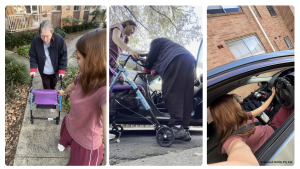
Transport funding is allocated based on your individual plan, your goals, and how your disability affects your ability to use standard transport options.
Our Assistance with Travel and Transport Arrangements service helps participants across Greater Sydney and Northern NSW travel to appointments, outings, and daily activities safely and comfortably.
How Flexible Is Your Core Support Budget?
One of the biggest advantages of Core Supports is flexibility, and it’s something many participants don’t fully realise they have.
Unlike Capital Supports (which are locked to specific items) or Capacity Building (which is locked to specific goals), your NDIS core support budget can generally be moved between the four sub-categories without needing to call the NDIS.
This means if you end up needing more daily activities support one month and less transport support, you can usually redirect that funding, as long as it’s all within Core Supports and it relates to your disability-related needs.
Important rule of thumb: You cannot move funding from Core Supports into Capital or Capacity Building categories (or vice versa). Flexibility only works within the Core Supports category itself.
Tip: Always check your specific plan, because some plans have stated supports that are “ring-fenced” or locked to a particular use. Your plan manager or support coordinator can clarify this for your situation.
What Can NDIS Core Supports NOT Pay For?
Knowing what’s not covered is just as important as knowing what is. Core Supports are not a general living allowance; they’re specifically for disability-related support needs.
Core Supports generally cannot pay for:
- Everyday living costs that anyone would have (rent, groceries, utilities, phone plans)
- Supports that are the responsibility of another system (Medicare-funded therapy, for example)
- Support that isn’t related to your disability
- Items or activities that don’t align with the goals in your plan
- Supports from family members in most circumstances (unless approved)
- Funding that has already been allocated in another support category
The NDIS uses a “reasonable and necessary” test for all funding decisions. If a support directly relates to your disability, helps you pursue your plan goals, and represents value for money, it’s likely to be approvable.
How Is Your Core Support Budget Managed?
How your NDIS core support budget is managed affects how you access and use it. There are three options:
NDIA-managed (Agency-managed): The NDIS pays registered providers directly. You can only use registered NDIS providers.
Plan-managed: A plan manager handles the invoices and claims on your behalf. You can use both registered and unregistered providers.
Self-managed: You manage your own budget, pay invoices directly, and claim reimbursement from the NDIS portal: maximum flexibility, but more administration.
School of Ability supports participants across all three management types, whether you’re self-managed, plan-managed, or NDIA-managed.
A Real-World Example: How One Participant Uses Their Core Support Budget
To make this tangible, here’s a realistic example of how core support funding might be used in a single month:
Meet Priya, a 34-year-old NDIS participant in Sydney with a physical disability affecting her mobility and personal care.
- Daily Activities: 10 hours/week of personal care support (showering, grooming, meal prep) funded under Assistance with Daily Life
- Community Participation: A support worker accompanies her to her local art group twice a week, funded under Social and Community Participation
- Transport: Monthly transport to medical appointments and community activities, funded under Transport
- Consumables: Monthly continence products, funded under Consumables
Across all four categories, Priya is using her core support budget exactly as it’s designed to give her the practical assistance she needs to live independently and participate fully in her community.
Core Supports vs. Capacity Building: What’s the Difference?
This is a common point of confusion, so it’s worth a quick clarification.
| Core Supports | Capacity Building | |
| Purpose | Every day support you need right now | Building skills for greater independence over time |
| Examples | Personal care, transport, community access | Life skills programs, therapy, and employment support |
| Flexibility | High (within Core category) | Lower (locked to specific goals) |
| Duration | Ongoing | Time-limited and goal-oriented |
Our Development of Daily Living and Life Skills service sits at the intersection of both, helping participants build practical independence while providing day-to-day support.
How to Get the Most From Your Core Support Budget
Here are five practical tips to help you use your NDIS core support budget effectively:
- Review your budget regularly. NDIS plans run for 12 months. Don’t leave it until the last minute to realise you’ve under- or overspent. Check your MyPlace portal monthly.
- Use your flexibility. If one category isn’t being fully used, ask your plan manager whether you can redirect it to a category you need more of.
- Align supports with your goals. Every support you fund should connect back to a goal in your plan. The clearer the connection, the easier your plan review will be.
- Choose the right provider. Your core support is only as good as the provider delivering it. Look for consistency, reliability, and genuine person-centred values, not just the lowest rate.
- Keep your service agreement current. Make sure you have a signed service agreement with every provider. This protects you and ensures clarity around what’s being funded.
Ready to Start Using Your Core Supports in Sydney or NSW?
Understanding what your NDIS core support budget covers is the first step. The next step is finding a provider who will actually use that funding to make a real difference in your life.
At School of Ability, we’re a registered NDIS service provider (Reg. No. 4053307717) delivering core support services across Greater Sydney and Northern NSW. We support participants across all six service types that fall under Core Supports, personal care, household assistance, community participation, innovative programs, life skills, and transport.
No waitlists. Free 30-minute consultation. 5-star rated.
Whether you’re self-managed, plan-managed, or NDIA-managed, we’d love to hear about your goals and show you what genuinely person-centred support looks like.
👉 Book your free consultation or call us on
FAQs
Can I use core support funding for a family member to provide my care?
Generally, no, the NDIS does not fund informal supports provided by family members unless there are exceptional circumstances and specific approval. Core Supports are intended for paid, qualified support workers.
Can core support funding be used for mental health support?
Some social and community participation supports can assist with well-being and connection. However, clinical mental health treatment is typically funded through Medicare or the health system, not NDIS core supports.
What happens if I run out of core support funding before my plan ends?
You can contact the NDIS to request an unscheduled plan review if your needs have significantly changed. Alternatively, work with your support coordinator to adjust how remaining funding is used across the sub-categories.
Can I use NDIS core supports for things like gym memberships?
Not directly. However, if a gym or exercise class is recommended as part of your disability support and a support worker accompanies you, that support worker's time can potentially be funded under social and community participation.