
Applying for the National Disability Insurance Scheme can feel overwhelming when you don’t know where to start. You’ll need to understand the eligibility criteria, gather supporting evidence, complete forms, and navigate the planning process before you receive your first NDIS plan.
If you have never done it before, you may feel confused about the process. First-time applicants often aren’t sure whether they will be accepted, what documents are required, or what happens after you submit your application.
This article will take you through the process of applying for the NDIS, including whether you are eligible to access the NDIS, your first planning meeting, and what your initial plan may look like. If you’re filling out the application for yourself or someone else, this guide will assist you in understanding each step before you do.
Please be aware that the NDIS legislation and guidelines are still changing. There will be major changes to eligibility assessments for new applicants in 2028, and other changes (funding resets, claim timeframes, etc.) are in progress. Please refer to the official NDIS website (ndis.gov.au) or call the NDIA on 1800 800 110 for the latest information.
What Is the NDIS and Who Can Apply?
The National Disability Insurance Scheme (NDIS) is an Australian Government scheme to fund and support Australians who have a permanent and significant disability. The National Disability Insurance Agency (NDIA) provides it.
The scheme is a principle of choice and control in relation to supports for people with disability. The NDIS is not a ‘one-size-fits-all’ plan; it is designed to provide funding for supports that are specific to a person’s disability related needs, goals and plans, within the legal definition of NDIS Supports.
It’s important to realize that there are multiple steps involved:
- Applying for access: submitting an application to become an NDIS participant
- Receiving an access decision & Notice of Impairments: the NDIA deciding whether you meet the eligibility criteria and issuing a formal notice that lists your recognized impairments
- Becoming a participant: being approved and entering the planning stage
- Receiving an NDIS plan: a funded, individualised plan that reflects your recognized support needs and goals, broken down into specific funding periods
- Accessing NDIS services and supports: using your plan to connect with providers and submitting claims within the required timeframes.
These stages are separate. Approval for access does not automatically mean you receive funded supports immediately, and the supports in your plan must relate directly to the impairments listed in your Notice of Impairments.
Understanding the NDIS Eligibility Criteria
To be eligible for the National Disability Insurance Scheme (NDIS), you must meet the following criteria:
- Not be 65 or older at the time of application.
- Be an Australian citizen, permanent resident, or have a Protected Special Category Visa, and live in Australia.
- Have a disability resulting from one or more permanent(or likely permanent) impairments: physical, intellectual, cognitive, neurological, sensory, or psychosocial.
- Have a disability that affects your everyday life.
Please note, a medical diagnosis does not automatically qualify someone to access the NDIS. The NDIS is about how your impairment affects you in your everyday life. Evidence must be presented clearly and with structure for each impairment category that is desired to be recognised.
You can apply more than once if your situation changes and you have new supporting evidence. Further changes to NDIS access and eligibility for new applicants are scheduled to begin from January 2028, including a new standardised, evidence-based approach to assessing functional capacity and changes to how permanence and other eligibility requirements are assessed.
If you’re not sure if you might be eligible, you should consult with a professional or contact the NDIS directly.
What to Prepare Before Applying for the NDIS

It is beneficial to have the proper information and documentation before starting the application process. A well-prepared process will be smoother and will avoid delays due to missing evidence.
These are the items you will need:
- Personal information: name, date of birth, contact information, proof of identity
- Residency information: evidence that you meet the residency requirements
- Details of your disability or impairment: the condition and duration of your disability/impairment
- Medical or professional reports: from treating practitioners (GPs, specialists, occupational therapists or psychologists)
- Documentation of functional impact: any documentation that shows how your disability impacts your daily functioning
- Details of current supports: any informal support, services or funding that you are currently receiving
The key element of your evidence is to show how your disability affects your life, not just your diagnosis. The NDIA must have an understanding of the actual effect of your impairment in the real world.
Think about how your disability affects areas such as:
- Personal care and self-management
- Communication and social interaction
- Mobility and getting around
- Learning and decision-making
- Community participation
The functional areas are covered with supporting evidence that directly addresses the areas, with real-life examples from your daily life.
How to Apply for NDIS: 5 Key Steps
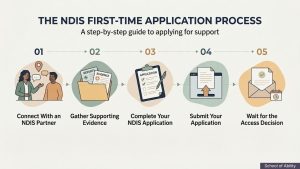
This section provides a step-by-step overview of the basics of the NDIS application process.
Step 1: Connect With an NDIS Partner
It may be helpful to talk to someone before filling out any forms to understand your options. This can be an NDIS Local Area Coordinator (LAC) depending on the circumstances and location.
A Local Area Coordinator is an NDIS partner who supports people to understand the scheme, to determine if they qualify, and to assist them in the application process. Whether or not you become an NDIS participant, an Area Coordinator can assist you to link in with community resources and other services.
Not all applicants will be supported by an LAC; for some applicants, they may directly contact the NDIA, or they may work with an Early Childhood partner if they are making an application on behalf of a child younger than nine. If you’re not sure where to start, it’s a good idea to contact an NDIS partner in your area.
NDIS partners can be located via the NDIS website by using the provider finder tool.
Step 2: Gather Your Supporting Evidence
One of the most crucial components of your application is supporting evidence. The NDIA may not have the information it needs to make an access decision in your favour if you do not have the appropriate documentation.
The evidence should be from a qualified professional who is familiar with your situation. Reports should be up-to-date, comprehensive, and include the functional impact of the diagnosis rather than just a diagnosis.
Have your health care providers explain:
- What is your disability or impairment and why it will not go away.
- How it affects your daily activities and independence
- What help you are currently receiving and why
The more specific and practical the evidence, the better your application will be.
Step 3: Complete your NDIS application
The NDIS Access Request Form is one way to provide the information needed to apply for access to the NDIS.
You don’t always need to complete the form yourself. An NDIS partner or the NDIA can help you make an application and provide the required supporting information. The form asks for:
- Your personal and contact information.
- Information about your disability and how it affects your life.
- Details of your treating professionals
- Details of your current support arrangements.
Please fill in the form carefully and thoroughly. Incomplete or ambiguous responses can slow down the process or may lead to a wrong decision that is not aligned with your situation. Where possible, use specific examples to illustrate how your disability affects your day-to-day life.
Step 4: Submit Your Application
After you have filled out the NDIS access request form and collected your supporting evidence, you can submit your application. This can be done by:
- Contacting the NDIS on 1800 800 110
- Filling out and submitting the form in person at an NDIS office or by mail.
- Submitting through an LAC or NDIS partner that can help with the submission
Once you have submitted your application and supporting documents, the NDIA will consider your application. If they lack information or do not understand something, they will reach out to you or your treating practitioners for further details. Prompt response to any such requests will help to prevent unnecessary delays.
Step 5: Wait for the Access Decision
Once your application and all supporting evidence have been received, the NDIA will determine if you meet the access criteria. This is referred to as the access decision.
The NDIA will consider your information and determine if your disability is eligible for the NDIS. You will be informed in writing of the result.
It’s important to note that the access decision is not the same as the first NDIS plan. You have been approved for access when you become an NDIS participant; the planning stage is afterwards.
How Long Does NDIS Approval Take in 2026?

A common question that is often asked by first-time applicants is: how long does it take to get approval for the NDIS?
Under the Participant Service Guarantee, the NDIA has up to 90 days to make an access decision once a complete application and all supporting evidence have been received. If the NDIA requests additional information, it then has a further 14 days to decide after that information is provided.
The 90 days only start when the NDIA has all the information they require. Applications that are not complete or evidence that is not functional will cause delays in the process, so it is important to submit evidence that is complete and functional from the beginning.
Once an access decision is made, the NDIA will strive to approve your first plan within 56 days. These are the timeframes that are guaranteed by the Participant Service Guarantee and may differ depending on the individual. Please refer to the official NDIS website for the latest performance information.
What Happens After Your NDIS Application Is Approved?
If you get a positive access decision, you are now an NDIS participant. The next step is to plan, which is the process of creating your first NDIS plan.
At this stage, you will meet with the NDIA or an NDIS partner to discuss your life, your goals and your disability-related support needs. Planning can occur by phone, video call or in person, depending on your location and circumstances.
During the planning conversations, the following are generally discussed:
- Your own lifestyle and situation
- Your habits and activities of the day
- Your short- and long-term goals
- The informal supports you currently have (family/friend support)
- Services and supports that you are currently accessing
- Areas where you need additional help
- Your independence and community participation goals
The information you collect in the planning process is used to create your first NDIS plan. The plan should be tailored to your own goals, situation, and reasonable and necessary supports that are related to your disability.
It is important to be as specific and honest as possible during planning conversations. The more clearly you can describe your needs and goals, the more accurately your plan is likely to reflect your situation.
NDIS Planning Meeting: What to Expect

Knowing what to expect at a planning meeting can help you to feel more prepared and confident.
The planning meeting is not a test! It is designed to assist the planner or LAC in understanding your life and your disability related support needs to create an appropriate plan.
What Will You Discuss?
You might be asked in the planning conversation about:
- The routines you have and how your disability impacts them.
- Your living arrangements and who supports you at home
- Your short-term and long-term objectives
- Your education or employment status (if applicable)
- Personal care needs and assistance with daily activities
- Engaging with the community and building social networks
- Informal supports from family, friends or carers
- Current services/supports received (if any)
- Areas where you need additional funded support
The best thing you can do is to give specific real-life examples instead of general statements. For example, if you need some help with personal care, you might want to say, “I need help getting ready in the morning because my condition affects my upper body strength and I can’t get ready on my own safely.”
The clearer the examples are, the clearer the planner will have an idea of what reasonable and necessary supports can be provided for you.
What Should You Prepare?
It is useful to have the following available before the planning meeting:
- The latest information from practitioners who treat patients.
- A list of goals (short-term and long-term) in writing
- A list of questions you want answered
- Specific examples of how your disability causes you difficulties every day.
- Information about existing supports, paid and unpaid
- Details of any services that are already in place.
Please feel free to have a support person (family member or disability advocate) attend the meeting if it would make you feel more comfortable.
What Can Your First NDIS Plan Include?
Your first NDIS plan outlines the specific supports and funding allocations agreed by the NDIA. Under the current legal definition of NDIS Supports, every funded item must directly relate to the impairments listed in your Notice of Impairments. The NDIS cannot fund everyday living costs, general health services, or items outside the approved list of disability supports.
Plans now include clear funding periods (rather than a single lump sum) so you can manage your budget across the life of the plan. From 1 October 2026, budgets for some supports in the Social, Economic and Community Participation and Improved Daily Living Skills categories are being progressively reduced for new and reassessed plans. The changes will be introduced over 12 months, with renewed plans affected from 1 February 2027. The impact will vary depending on a participant’s individual goals, circumstances and support needs.
Typical supports in first NDIS plans are in the following areas:
- Assistance with daily activities: support with tasks like cooking, cleaning, and personal hygiene
- Community participation: supports to help you connect with your community and have social connections
- Capacity building supports: supports that will help to build your independence and skills over time
All funded supports in your plan must be considered reasonable and necessary in relation to your disability.
Common Mistakes First-Time NDIS Applicants Should Avoid
Sometimes it’s important to know what not to do, as well as what to do. Here are some of the most common pitfalls of first-time applicants:
Assuming a diagnosis guarantees eligibility
The NDIS funds supports based on the functional impact, not diagnosis.
Ignoring the Notice of Impairments
Assuming you can use NDIS funds for supports that do not relate to the impairment categories listed in your official Notice of Impairments. All funded supports must address needs arising directly from those recognised impairments.
Attempting to use funds for non-NDIS supports
Requesting or claiming standard living expenses (e.g., rent, standard groceries, general holiday travel) that fall outside the defined list of approved NDIS supports.
Submitting incomplete or vague evidence
Submitting incomplete or unclear evidence can delay an application or make it harder for the NDIA to determine whether you meet the access requirements.
Treating your plan as a single lump sum
Overspending early without accounting for designated funding periods(e.g., quarterly or annual budget caps).
Missing claim timeframes
From December 2026, NDIS claims must be submitted within 90 days of the support being delivered. From 15 October 2026, claims submitted more than 90 days after a support was delivered may also be subject to additional integrity checks and may be held while the NDIA requests further information or evidence.
What to Do After Receiving Your First NDIS Plan

If your first plan is activated, follow these steps:
- Read your plan carefully: understand what supports have been funded and where they are in your plan.
- Review your goals: make sure the goals in your plan accurately reflect what you discussed during planning.
- Understand how your plan is managed: your plan may be NDIA-managed, plan-managed or self-managed.
- Know your funding and budgets: what is included in each budget category and what it can be spent on.
- Look for supports: match funded supports to services to support your goals.
- Find suitable providers: search for registered NDIS providers who can provide the supports in your plan.
- Ask questions before signing up with a provider.
- If you are unsure, ask for assistance: Your LAC, plan manager, or disability advocate can help you understand your plan if you are not sure.
Conclusion
The NDIS process is complex and can be intimidating at first, but with some preparation and understanding, it can be much easier. The process includes the steps of checking eligibility, gathering evidence, applying, getting an access decision, planning, getting your first plan, and understanding your plan.
Knowing how to apply for the NDIS and what to expect at each step will help you to advocate for yourself, or for someone you care for, through the process.
School of Ability offers disability support information and services to help participants learn about the NDIS and access appropriate supports. If you have questions about the process or need guidance after you receive your first plan, check out our resources with practical information for participants and their families.
Frequently Asked Questions
How do I apply for NDIS for the first time?
If you want to apply for the NDIS, call the NDIS on 1800 800 110 or get in touch with a Local Area Coordinator in your area. You will need to fill in the NDIS access request form and submit supporting evidence from treating practitioners to show how your disability impacts your daily life.
What is the NDIS access request form?
The NDIS access request form is the form for applying for access to the National Disability Insurance Scheme. Gathers data on who you are, your disability, how it affects you, and what supports you have. Can be done with assistance from an LAC, disability advocate, or support person.
What are the NDIS eligibility criteria?
The NDIS is available to people who are under 65 years of age, Australian citizens or eligible residents, and have a permanent impairment that substantially impacts on their ability to participate in everyday activities. Functional impact is the criterion, not diagnosis.
How long does NDIS approval take?
Once the NDIA receives a complete application and all supporting evidence, it has up to 90 days under the Participant Service Guarantee to make an access decision. If more information is requested, a further decision is due within 14 days of receiving that information. After a positive access decision, you will also receive a Notice of Impairments, and the NDIA aims to approve your first plan within 56 days. Timeframes can vary, so always check the official NDIS website for the latest information.
What should I expect at my first NDIS planning meeting?
Your planning meeting is a discussion about you, your goals, and your disability support needs. Questions will be asked about your daily activities, personal care, involvement in the community, supports you currently have, and what you would like to achieve. Bring specific examples of daily challenges, a list of goals, and any questions you may have.